Mother and daughter celebrate Harter Heights, then and now
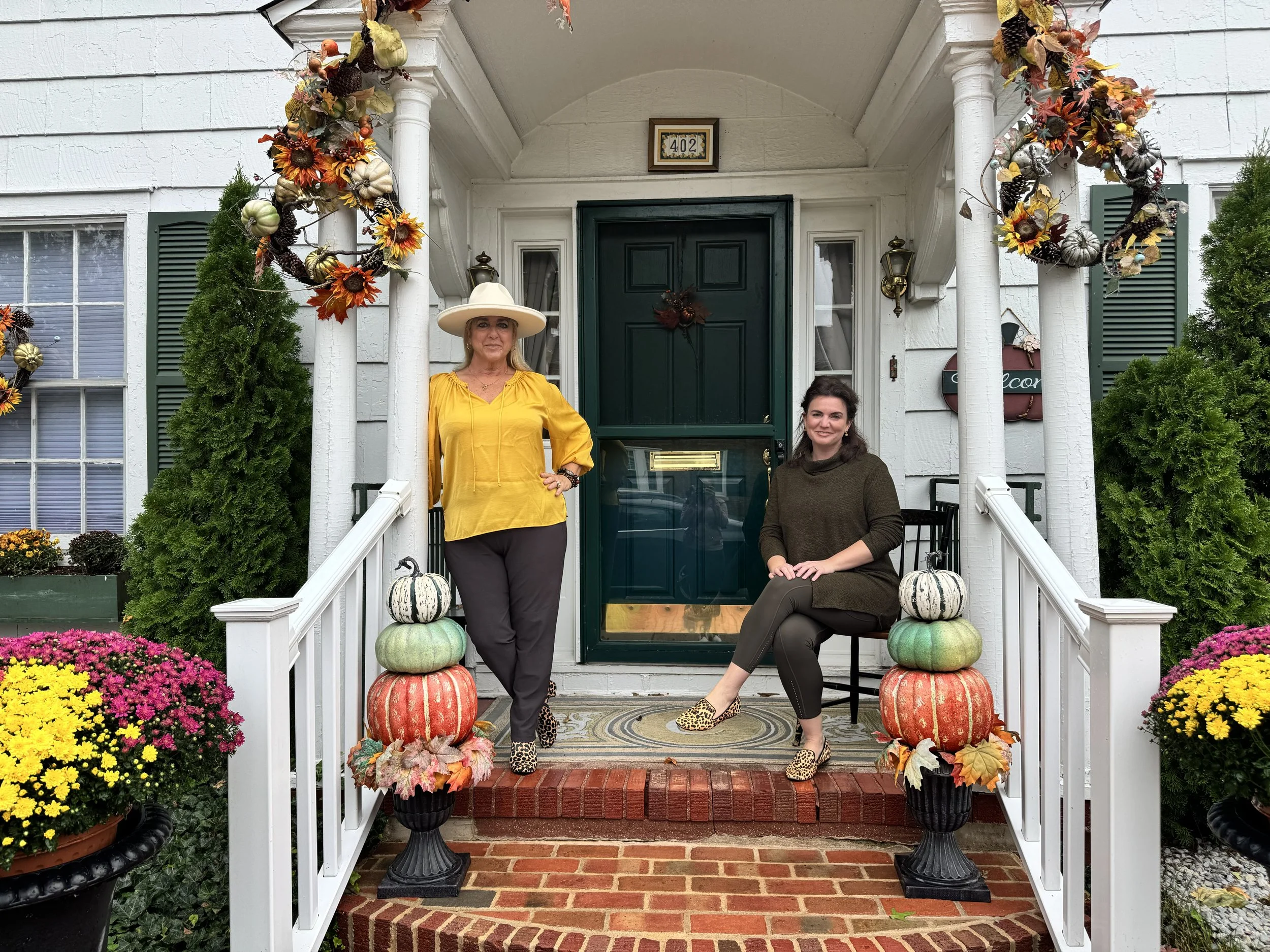
Pictured on the left is Lisa Caponigri and daughter Felicia, right, outside their home in Harter Heights, a neighborhood within the NEN. (Photo by Kristin Givens, South Bend Heritage)
By Felicia Caponigri, Harter Heights and NEN resident
Each of us has memories of the neighborhood of our youth, whether it’s here or somewhere else. We remember growing up knowing when our parents arrived home, seeing them through the kitchen or living room window. We likely have memories of playing with friends outside, learning how to ride our bikes, manning lemonade stands, catching fireflies, and grilling for holidays and on ordinary summer days.
My mother Lisa Caponigri and I grew up in Harter Heights, which is immediately south of the Notre Dame campus on the northern edge of what the city of South Bend calls the Northeast Neighborhood. We still make memories here in our family home—the white colonial with green shutters on Stanfield at the intersection of Angela Boulevard. Our extended family has lived in Harter Heights, in various houses, since the late 1950s and helped to build the feeling of community here.
Here are our memories of our neighborhood which we share in the hope that as times change, some things remain the same in the most important ways.
Lisa’s childhood memories
Harter Heights is more than a physical place, it’s a feeling and an atmosphere. History and uniqueness pervade every home and the story of every family in that home. If you walk on Pokagon, Peashway, or Napoleon, you’ll see solid Midwestern-style houses built as early as the 1920s in what used to be farmland with open fields and horses. A mix of colonial, ranches, prairie, and tudor homes (some with Michigan basements) stand proudly as testaments to important moments in local, national, and personal histories. Indeed, each of these homes has played a role in family histories and neighborhood lore.
In the 1950s, 1960s, and 1970s there was a “come home when the streetlights come on” feel to the neighborhood, where many dads worked as faculty at Notre Dame and most moms stayed home with the kids.
In my mind’s eye, there’s the house on Pokagon with the vibrant multi-colored stone where art professor and religious sculptor Ivan Mestrovic lived with his wife. The scene of Mrs. (Olga) Mestrovic serving tea seems almost perceptible if you look closely enough. Walking along St. Joseph Street, stepping over the cracks in the sidewalks that have been there since your childhood, you don’t just see the neighborhood, you feel the neighborhood. If you turn at just the right moment, hop over a crack and peek to your left, you might just see, in between two houses, a woodshed where hide and seek was played, with friends from your childhood nestled behind the piles of cut wood for fireplaces which kept families warm through long Indiana winters.

Pictured in this 1961 photo are Lisa and her relatives in front of her family's home at 317 East Napoleon Blvd. From left to right are Julia Franco (cousin), Catherine Franco (grandmother), Topsy Franco (aunt), Alice Franco (cousin), Lisa, Victoria Caponigri (sister), and Robert Caponigri (brother). (Photo provided.)
There’s the house on Napoleon where a faculty couple—our family—hosted Cardinal Giovanni Montini for a decadent, elegant dinner in the 1960s and formed a friendship before he ascended to the papacy in 1963 as Pope Paul VI. There’s the home at the corner of St. Joseph and Pokagon, where any time a child knocked on the door to ask for candy, candy would be given. (Whether it was Halloween or not!) Then there was the big house on Angela Boulevard, with the turnaround driveway, that lit their big pine tree in the front yard every Christmas season. It felt like it was the Christmas tree for the whole neighborhood.
Many lifelong friendships in Harter Heights were formed by “faculty brats,” children of (mostly male) faculty members who were bound together by their workplace and a closeness and camaraderie born from piano sing-along sessions and intellectual discussions among our fathers that we children heard late into the night. The smell of cigar smoke might waif up to a child’s bedroom as they heard their fathers vigorously discuss philosophical ideas with neighbors, who were also colleagues.

Pictured, from left to right, in this 1968 photo are Lisa and her extended family: Catherine and Franklin Franco (grandparents), Winifred and A. Robert Caponigri (parents), Victoria (sister), Robert (brother), and Lisa. They are standing at the corner of Stanfield and Napoleon, in front of the family home at 317 East Napoleon Blvd. (Photo provided.)
Children would know whose mother cooked the best brownies (and whose mother preferred reservations) and would plan their sleepovers accordingly. On late nights in kitchens in the 1970s, after Vatican II had fundamentally changed the Mass, six or eight young women who were members of Sacred Heart Parish at Notre Dame would bake bread together to share for Eucharist the next morning.
For every memory that seems out of a film like “Now and Then,” there’s another memory of a father grilling in the backyard with neighbors and then walking up to campus the next morning to teach his classes. Or a neighbor, known for their prowess at making a mean Manhattan, who would be leaving the next morning on a flight for a meeting at the Vatican, or be packing to board a plane for a national championship game.
Every football Saturday, faculty couples (our parents) would gather at their corners with blankets on their arms and cocktails in their hands, ready to walk up to the stadium to cheer on their students. Waving to them from the backyard, their children could hear the crunch of the dried leaves under their shoes as they ran with excitement (and without parental supervision) down the alley to meet their friends.
Felicia’s childhood memories
Flash forward to the 1990s, and while some things changed, most did not. If you went trick or treating, say, as a 12 year old who was hoping to be incognito as a 1920s flapper, you were still recognized by your grandmother’s friends who were giving out candy.
A multi-generational exchange was just part of everyday life.

Pictured in this 1990 photo are Felicia, right, and her brother Bobby sitting outside their home at 118 East Angela Blvd. (Photo provided.)
Wishing you could stay in your pajamas over Christmas break and watch your favorite shows on Nickelodeon? Your grandmother had other ideas—she was having a New Year’s open house (not the real estate kind, the neighborly kind that happened in pre-Facebook days where you would drop in and share an update on the past year and your hopes for the year to come). You had to attend and, not only did you inherit your mother’s chore of straightening the tassels on the living room rugs, but you were also expected to share, in a very grown up tone, your scholastic achievements and goals with her social set. And, if you stood too close to the cucumber sandwiches made for the open house buffet and snacked on too many, you were sure to be reminded that those sandwiches were for the guests.
When your grandmother lived in Harter Heights, along with your mother, being a student at Holy Cross College, Saint Mary’s College, or Notre Dame in the 2010s meant that you were never “away” at college. And that wasn’t a bad thing. Professors who would otherwise be distant intellectuals pontificating from the lectern were people you’d met around a dining room table at home, or seen as part of a “birthday club” lunch at the now-demolished University Club. Father Peter Rocca, the rector of Notre Dame’s Basilica, wasn’t just the presider of a Sunday Mass where you sang with the Folk Choir. He was the man who wanted to find out where your mother bought her outdoor plates in that vibrant Capri design because his sister happened to love entertaining just as much as she did.
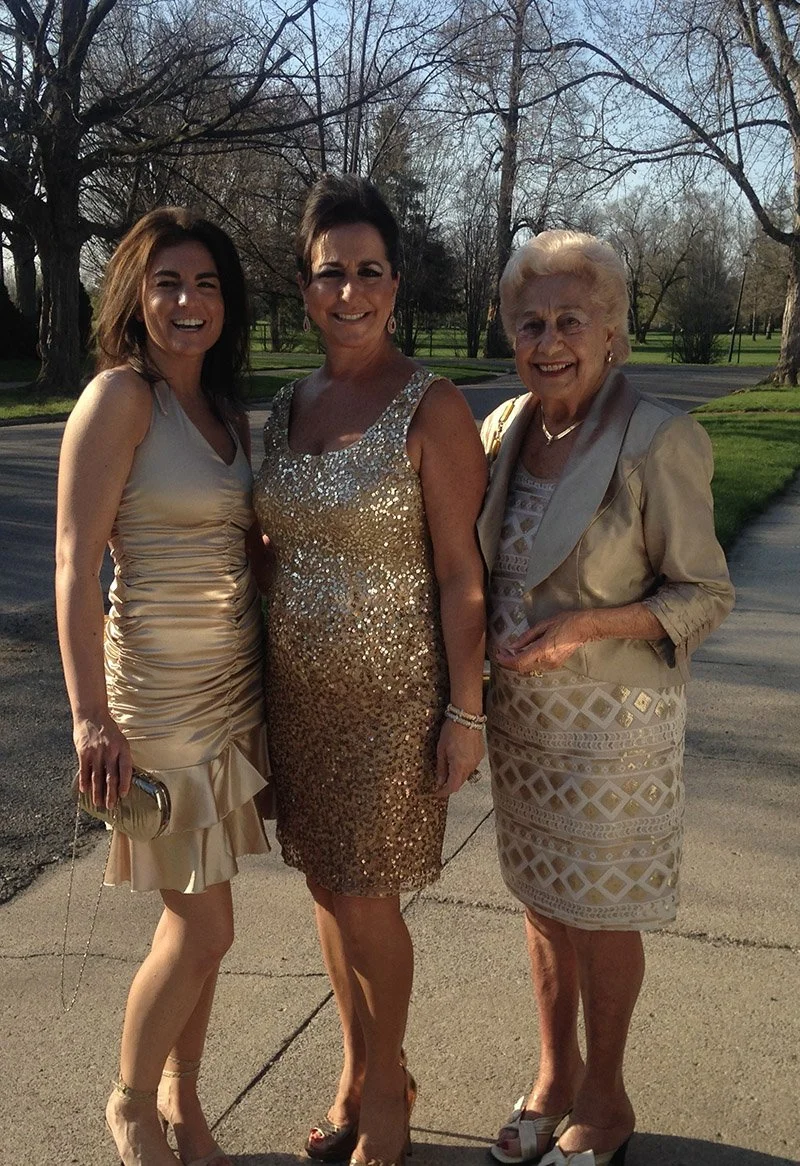
Three generations of Caponigri women—Felicia, Lisa and Winifred—pose for photo in front of the family home at 402 E. Angela Blvd. (Photo provided.)
Football Saturday celebrations after a game might start with dinner at your mother’s house and end at the Linebacker. You’d bring your friends to a party where the guests were a hodgepodge of your parent’s and grandparent’s former students—alumni who might have been on the GI bill while at Notre Dame or been fed around a Thanksgiving table decades ago—and “faculty brats” whose parents had moved on to other academic institutions but who remained faithful Irish fans and were in town for the game. These football dinners opened opportunities as much as they helped to create more memories. A family friend who lived down the street and knew your grandfather, could share over pot roast a story about him that you had never heard. Interested in going to law school? A judge or partner at a law firm might be on hand to answer your questions.
All this serendipity happened in large part because of the neighborhood and its community. Harter Heights brought a sense of belonging across property lines and generations. Neighbors were bound together by the pursuit of something greater—be it theology, science, music, or sport—and created opportunities for dialogue and support rooted in memories, nostalgia, and principles that could last a lifetime.
The more things change…
Neighborhoods inevitably change, families move away, long-term residents pass away, houses are sold, and new neighbors are met.
It is true that Harter Heights is changing. We have more alumni who visit on football weekends and aren’t able to make the neighborhood theirs full time. We have more unshoveled sidewalks in the winter, fewer old-school open houses to attend, and more construction happening than we expect. But multi-generational homes can still be found in Harter Heights. You will also find many Notre Dame faculty and staff who live here and there are new homeowners who call Harter Heights home year-round.
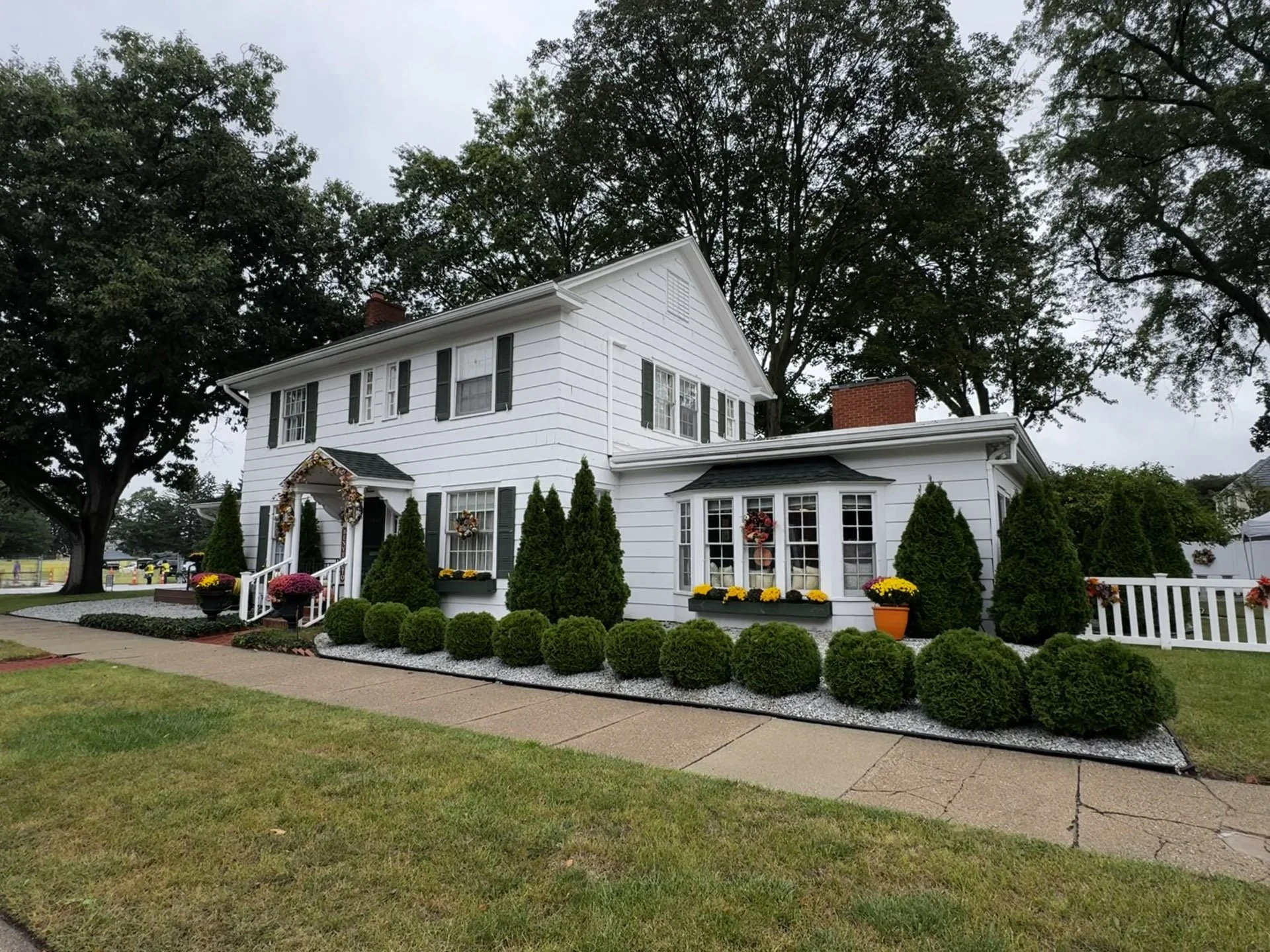
The Caponigri’s current home at the corner of Angela Blvd. and Stanfield is one of several Harter Heights homes the extended family has owned over the generations. (Photo by Kristin Givens, South Bend Heritage)
To all those who own homes in Harter Heights we say, savor the character of the neighborhood. That fence you are fixing was once a meeting point for two neighbors who traded perspectives on their tomato gardens. A backyard between a home on Napoleon and one on Peashway was a meeting point for two pets who sent each other Valentine’s Day cards with paw prints. You can’t imagine all that’s happened here: the crises and renewals of faith; the moments of discernment and joy for career milestones, graduations, and new babies; or the feeling of seeing neighbors walk across the street to ask if help was needed when an ambulance pulled up to help a loved one in need.
Harter Heights is more than a “party next to the stadium” neighborhood. There are still backyard birthday parties, bake sales, and neighbors who protect trees from overzealous trimmers and children from speeding cars. And you can still find neighbors sitting in lawn chairs on their driveways waving to people passing by and exchanging stories about the week (and maybe how good the pizza was at Rocco’s last night).
Whether you live here full time or come in for home games, you will find Harter Heights will live inside you forever. That feeling of home is the foundation of its history.
Editor’s note: Felicia Caponigri is an Assistant Professor of Law at Marquette University Law School in Milwaukee, Wisconsin, and grew up between Harter Heights and Italy. Lisa Caponigri, a Double Domer and former Faculty member at Notre Dame who has lived her life between Harter Heights and Italy, is the author of two cookbooks on Sunday Dinner, with two more cookbooks forthcoming.